
The Science Behind the Art
You have walked past it a hundred times. The mural on the wall. The colours that do not fade. The proportions that look exactly right. None of that happened by accident — it happened because of science and technology. And understanding how it works is the first step to making something extraordinary yourself.
Withington News
The Accident That Changed Everything
A French philosopher asks why the greatest scientific discoveries were never planned. The answer is on your wall.
Withington News
Before a single brushstroke goes on a wall, a mural artist opens an app. They sketch the composition on a tablet, adjust the palette using colour-theory tools built on mathematics, and calculate the proportions using geometry. The paint that survives Manchester rain was engineered in a laboratory. The image you walk past every morning on Copson Street is the end product of a chain of science decisions, most of them invisible. This is what science actually looks like. Not a whiteboard. Not a laboratory. A wall in Withington.
Marc Halévy's 14 Grands Génies entre Science et Spiritualité — published in French, not yet translated into English — makes a deceptively simple argument: the greatest scientific discoveries in history were not planned. They were accidents, mistakes, unexpected moments noticed by a mind that was paying attention.
Fleming was not looking for an antibiotic. He was looking at a contaminated petri dish and had the presence of mind not to throw it away. Becquerel — French, like Halévy — was not trying to discover radioactivity. He left uranium on a photographic plate in a drawer during a cloudy week in Paris in 1896, came back to find it fogged, and asked why. The Curies followed that question for the rest of their lives.
The discovery was not the result of a plan. It was the result of a prepared mind meeting an unexpected moment.
Röntgen noticed a glow on a screen across the room. Goodyear dropped rubber on a hot stove. Hofmann absorbed a compound through his fingertips on a Friday afternoon in Basel and spent the weekend understanding what had happened to him. In every case, the discovery was not the result of a plan. It was the result of a prepared mind meeting an unexpected moment.
Halévy's deeper point is about how we teach science — and how we should. The curriculum presents science as a series of correct answers arrived at by correct methods. The history of science tells a different story: a story of wrong turns, contaminated samples, broken equipment, and moments of confusion that turned out to be more valuable than the experiment that was supposed to work.
The quality that connects all fourteen of his geniuses is not intelligence in the conventional sense. It is attention. The willingness to stop, look at the thing that went wrong, and ask: but why?
Withington is surrounded by institutions where this kind of thinking happens every day. At The Christie, researchers run clinical trials whose most important results are sometimes the unexpected ones — the side effect that turns out to be a treatment, the compound that does something nobody predicted. At the University of Manchester, graphene was discovered not in a grand experiment but with a piece of sticky tape and a pencil. André Geim and Konstantin Novoselov were playing. They called it their Friday night experiments — time set aside to try things that probably would not work.
The mural on the wall at Copson Street began the same way. Someone decided to try something. The science that made it possible — the colour algorithms, the UV-resistant pigments, the geometry — was assembled from discoveries that each began with a question nobody had planned to ask.
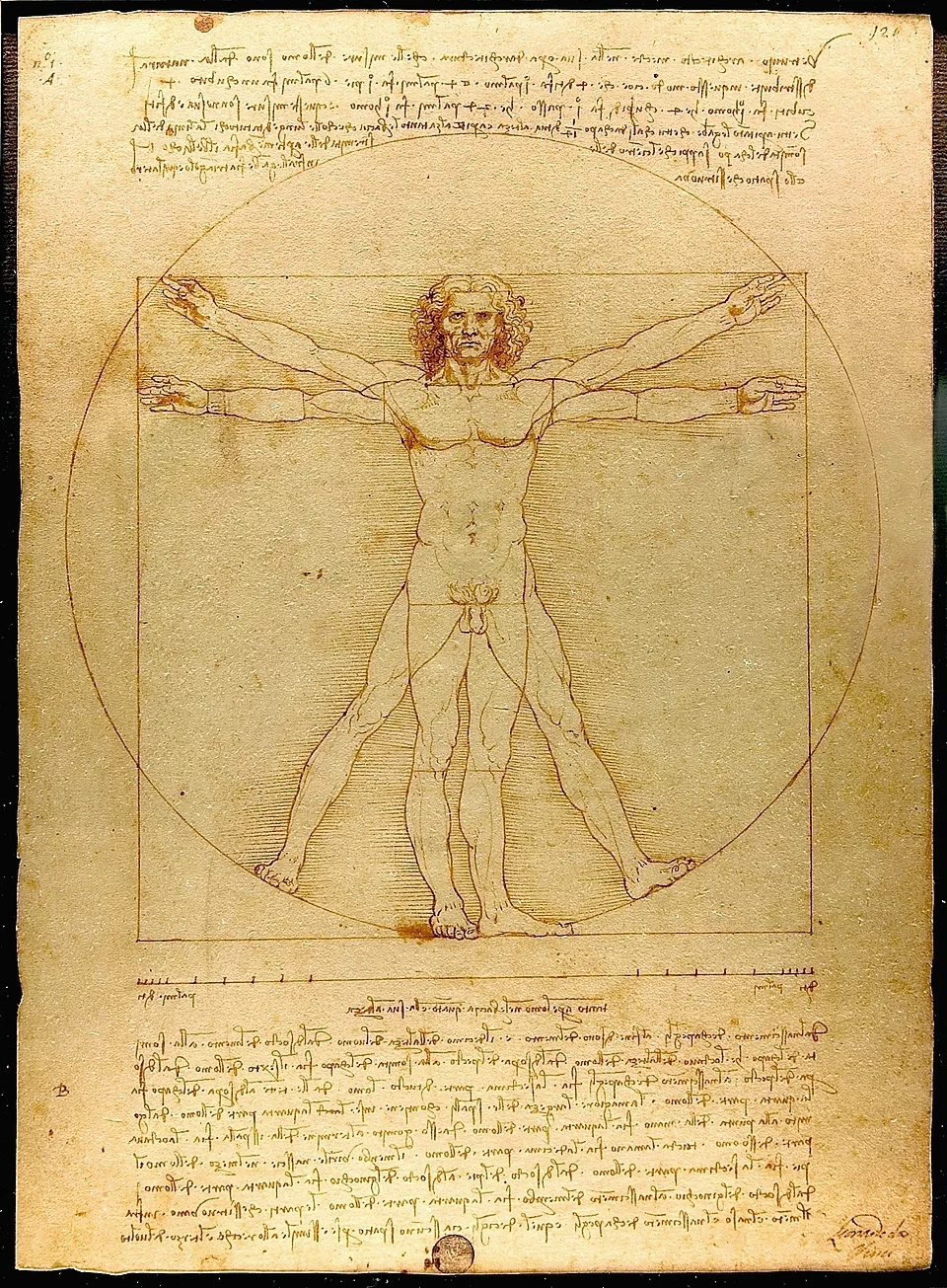
That quality is not new. It did not begin with Fleming or Becquerel. It is there in the notebooks of the artists who first tried to understand the human body not as a symbol but as a fact — who looked carefully at the thing in front of them and refused to paint it until they understood how it worked from the inside. The Vitruvian Man is not a drawing of a body. It is a record of someone paying attention.
The mural on your wall belongs to the same tradition. Someone looked carefully. Someone asked why. The science was already there.
2027 — The shift point
When the accident is a war
Halévy's fourteen geniuses all shared one quality: they were prepared for the unexpected. They had done the reading, the thinking, the practice — so that when the moment arrived, they could see it for what it was. The unprepared mind looks at the fogged photographic plate and sees a ruined experiment. The prepared mind looks at the same plate and discovers radioactivity.
We are approaching a moment that will require the same quality — not in a laboratory, but in ordinary life. The geopolitical pressures converging on 2027 are not hidden. They are in the newspapers, in the think-tank reports, in the statements of heads of state. France is locking Europe into a confrontation with Russia before its 2027 elections close the political window. Germany is rearming. The US Congress has restored Ukraine funding. The neoconservative faction is back in control. Kaliningrad is a time bomb. The front line is not stabilising.
The unprepared mind looks at the fogged plate and sees a ruined experiment. The prepared mind discovers radioactivity.
The generation that grew up after 1945 was the first in European history to assume that peace was the default. It was not. It was the exception — the product of specific political arrangements, specific deterrents, specific memories that are now fading. The prepared mind does not assume the experiment will go as planned. It watches for the unexpected result.
The question Withington News is asking — are you prepared for the coming war? — is not a provocation. It is the same question Halévy is asking about science. Not: do you have the right answer? But: are you paying attention? Are you ready to see what is actually in front of you?
Read the full analysis and cast your vote →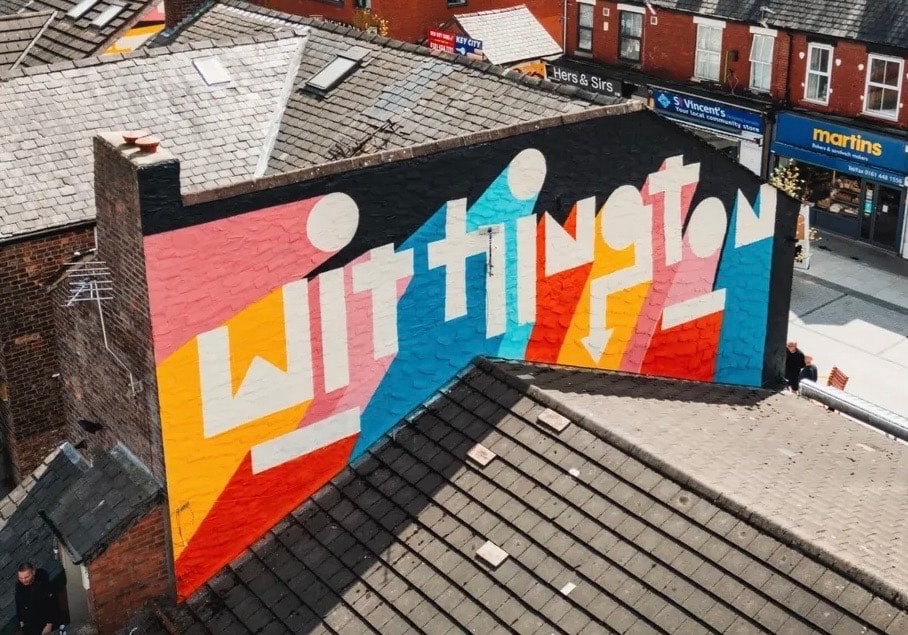
Look at the wall. Now look again.
Before a single brushstroke goes on a wall, a mural artist opens an app. They sketch the composition on a tablet, adjust the palette using colour-theory tools built on mathematics, and calculate the proportions using geometry. Some artists project the design onto the brickwork using a digital projector — the same technology used in cinemas and operating theatres. The image you walk past every morning is the end product of a chain of technology decisions, most of them invisible.
The paints themselves are a chemistry story. Pigments are engineered for UV resistance so the colours survive Manchester sun and rain. The primers that bond paint to brick are polymer science — the same discipline behind the plastics in your phone and the lining of your water pipes. The scaffolding that holds the artist in place is structural engineering. Even the decision about which wall to use involves data: footfall counts, sun angles, surface porosity.
This is what science actually looks like. Not a laboratory. Not a whiteboard full of equations. A wall on Copson Street, designed by a person with an app, painted with chemistry, standing up to the weather because of materials science. Every subject on the school curriculum had a hand in it.
From the wall to the world
The same principles that keep a mural bright for twenty years are used to coat aircraft wings, protect offshore wind turbines, and develop new cancer treatments at The Christie, which sits at the end of Wilmslow Road. The geometry that makes a mural look right from fifty metres away is the geometry used to design buildings, bridges, and the microchips inside every device you own.
Withington is surrounded by some of the most important scientific institutions in the world. The University of Manchester, birthplace of graphene and home of two Nobel laureates, is minutes away. Jodrell Bank, the Christie, Manchester Science Park, Wythenshawe Hospital's research teams — all of them are neighbours. This section exists to draw the line between the art on your wall and the science behind it, and then follow that line all the way to the people doing the work.
For the young scientists of M14, M20 and M21
If you have ever looked at a mural and wondered how the artist got the colours so right, or how the image stays sharp from far away, or why the paint does not peel off in winter — you were already thinking like a scientist. Those are real questions with real answers, and the answers lead somewhere interesting.
Colour mixing is chemistry. Proportion and perspective are mathematics. The app the artist used was built by a programmer. The paint was tested by a materials scientist. Every part of that wall connects to a subject, and every subject connects to a job, a career, and a way of seeing the world that most people never get shown.
We will be asking local researchers to explain their work in plain English, starting from things you can already see. We will cover open days, school events, and opportunities to meet scientists in south Manchester. If you are curious — this section is for you.
Are you a researcher or scientist in south Manchester?
We are looking for contributors — people willing to share their work with a local audience in plain English. Whether you study stars, cells, code or climate, we want to hear from you.
Latest stories
First stories coming soon
We are reaching out to local research institutions, mural artists and scientists. Our first features — starting with the science behind Withington's street art — will appear here shortly.